Why I Switched from OpenClaw to Viktor (And Stopped Re-Explaining My Business Every Day)
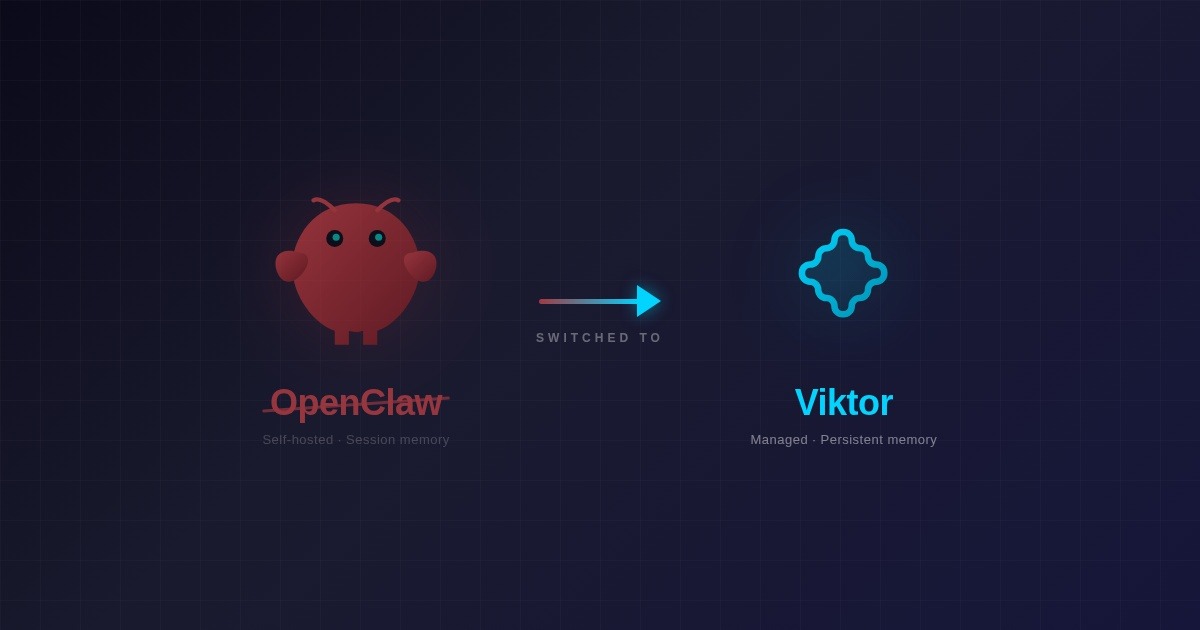
When OpenClaw came out in late January, I jumped on the bandwagon and created my first AI agent.
I spent months working with "Owen."
I wrote about it in an earlier article. I even recommended it.
The open-source framework was impressive, at first, and the community was growing fast. I had real workflows running through it: content publishing, Google Ads monitoring, lead qualification, phone answering.
But it was also... frustrating. And expensive.
Then I looked at my token bills and realized I was spending almost as much reminding Owen what we were working on as I was on the actual work getting done.
So I switched to Viktor. And I'm not going back.
The "50 First Dates" Problem
If you've seen the movie, you know the premise.
Drew Barrymore's character has short-term memory loss. Every morning, Adam Sandler has to start from scratch. Every day is day one. She doesn't remember yesterday's conversation, yesterday's breakthrough, or yesterday's plans.
That's what working with OpenClaw felt like.
The experience was fragmented. I'd spend 20 minutes on Monday getting the agent dialed in on a specific workflow, and by Wednesday it was asking me questions I'd already answered.
The context would drift.
The agent would lose track of decisions we'd made.
Every single day, Owen forgot what we were doing. Not just the nuance — the basics. He'd forget he had API access to my tools. I'd say "check the Google Ads account" and he'd tell me he didn't have access. He did. I'd tell him "check your mem" for the hundredth time. He'd find the credentials, act surprised, and then we'd finally get to work — 15 minutes and a pile of tokens later.
It wasn't occasional. It was every day. Every thread. Every time.
The Token Burn Nobody Talks About
Here's the other thing that pushed me over the edge, and it's something the AI industry doesn't want you thinking about too hard.
Token-based AI conversations are designed to keep you talking. Every clarifying question burns tokens. Every "let me make sure I understand" response burns tokens. Every time the AI asks you to confirm something it should already know — tokens. The more back-and-forth, the more you pay. The business model literally rewards the AI for being inefficient.
With OpenClaw, I was paying for API tokens directly through the LLM providers. So I could see exactly what was happening. And what was happening was ugly.
A huge chunk of my token spend wasn't on productive work. It was on context recovery. Here's what a typical session looked like:
- Me: "Pull the performance data for the Tampa Bay roofing campaign."
- Owen: "I don't have access to Google Ads."
- Me: "Yes you do. Check your mem."
- Owen: "Ah, I see I do have API credentials stored. Let me access that now."
- Me: "Also reference the strategy doc we wrote last week."
- Owen: "Can you point me to where that's stored?"
- Me: "Same place it was yesterday when you accessed it fine."
That exchange right there? That's real money. Not because any single message costs much, but because this happened at the start of every session, for every project, every day. I was paying the AI to re-learn things I'd already taught it. Multiply that across a dozen daily workflows and you're burning serious budget on digital amnesia.
The Real Cost of Running Your Own AI Agent
And the token waste wasn't even the full picture. Running Owen on OpenClaw meant a dedicated Mac mini humming 24/7, plus the API token costs on top of that. When I added it all up — hardware, electricity, API fees, and the hours I spent every week on maintenance, debugging sessions that broke, re-establishing context that got lost, configuring integrations manually — the total cost was staggering for what I was getting back.
The monthly API token costs looked reasonable in isolation. But when I broke down where the money was actually going, a huge portion was wasted on:
- Re-establishing context at the start of every session
- Arguing with the agent about what API access it had
- Re-explaining project details it had already been told
- Conversational overhead — all the "let me understand" and "can you clarify" exchanges
- Failed attempts that had to be re-run because the agent lost track of requirements
That was the problem. Not whether the AI could work. It could. I proved that. The problem was how much of my time and money went toward the AI actually doing things versus how much went toward reminding it what things needed doing.
Enter Viktor
The first thing I noticed after switching to Viktor was that I stopped repeating myself.
I told Viktor once that I run a digital marketing agency. That I manage Google Ads for contractors. That my blog uses a specific Tailwind template deployed on Cloudflare Pages. That I like direct writing with no filler. That my Cloudflare account ID is X and the project name is Y.
It remembered. Not for that session — permanently.
Viktor uses a skills system that acts like persistent memory. Every piece of knowledge it learns about your business gets stored in structured files that it reads before every task. When I ask Viktor to deploy a blog post, it doesn't ask me where the site lives. It doesn't ask about the template. It doesn't ask for API credentials. It already knows all of that, because it learned it once and never forgot.
Two months in, Viktor knows more operational detail about my business than most employees would after six months.
Viktor Executes. It Doesn't Chat.
But the persistent memory wasn't even the biggest difference. It was the interaction model.
Viktor doesn't try to keep me in a conversation. I send a message — "write a blog post about AI estimating tools for contractors" — and Viktor goes away. It researches. It writes. It generates the hero image. It updates the listing pages. It stages everything. Then it comes back and says "here's the article, ready to deploy, approve the token." One message from me, one result back.
No clarifying questions about things it should know. No "just to confirm" exchanges. No 15-message thread to accomplish what should take one instruction. The token spend goes toward actual output, not toward the AI figuring out who I am and what we're doing.
And the cost? Viktor's subscription is half of what I was paying to run Owen — and that's ignoring the actual cost of the Mac mini itself. The cost per useful output dropped dramatically because nearly all of the compute goes toward productive work instead of context recovery.
What This Looks Like Now
Right now, Viktor publishes two blog posts a week to this site on a schedule. It writes the article, generates the hero image, updates all the listing pages, and deploys to Cloudflare Pages. When Owen was handling blog content, I'd spend 30 minutes per post just getting him oriented. With Viktor, I approve a deployment token and move on.
Viktor monitors my Google Ads accounts. It manages client campaigns. It runs a daily trading strategy on my brokerage account. It fixed broken links across 14 articles on this site in one pass after I pointed out a single broken image. It does all of this without me explaining how any of it works each time, because it learned once and it stuck.
Owen would have needed a full briefing at the start of each of those tasks. And then another one tomorrow. And another one the day after that. All billable to my API account.
Credit Where It's Due
OpenClaw opened the door to what was possible with AI agents. Without OpenClaw, there would be no Viktor. It proved that AI agents could do real work for real businesses. It showed me — and thousands of other people — what was possible when you gave an AI access to your tools and let it execute.
Viktor just solved the problems that OpenClaw couldn't. The memory. The cost. The constant hand-holding.
If you're running an AI agent and you find yourself typing "check your mem" or re-explaining your business every morning, you're not using a tool. You're babysitting one. And you're paying for the privilege.
I liked OpenClaw. I still respect the project and the community behind it. But I needed an AI that knew my business as well on Friday as it did on Monday. That's not a feature request. That's the whole point.
I switched because the ratio was wrong. Too much of my spend was on recovery and repetition. Now nearly all of it goes toward output. That's not a philosophical preference. That's a line-item difference on my monthly expenses.
If you want to test the difference yourself: Viktor gives you $100 in free credits with no credit card required. getviktor.com Give it one task that you currently have to re-explain every time. You'll feel the difference in the first conversation.

Mike Slatton
Founder, Pro Level Gear LLC — Building AI-powered marketing systems for small businesses.